
Sweet Powerhouse: How Brazil Dominates the Global Sugar Market
- Admin
- 5月22日
- 讀畢需時 2 分鐘

Brazil isn't just famous for its samba, football, or Amazon rain forest—it's also the undisputed titan of the global sugar industry. As of 2025, Brazil continues to lead the world in both sugarcane cultivation and sugar production, turning the tropical nation's fertile land and long harvest season into a multi-billion-dollar export empire. Here's an inside look at what fuels Brazil’s sugar supremacy—and the challenges that lie ahead.
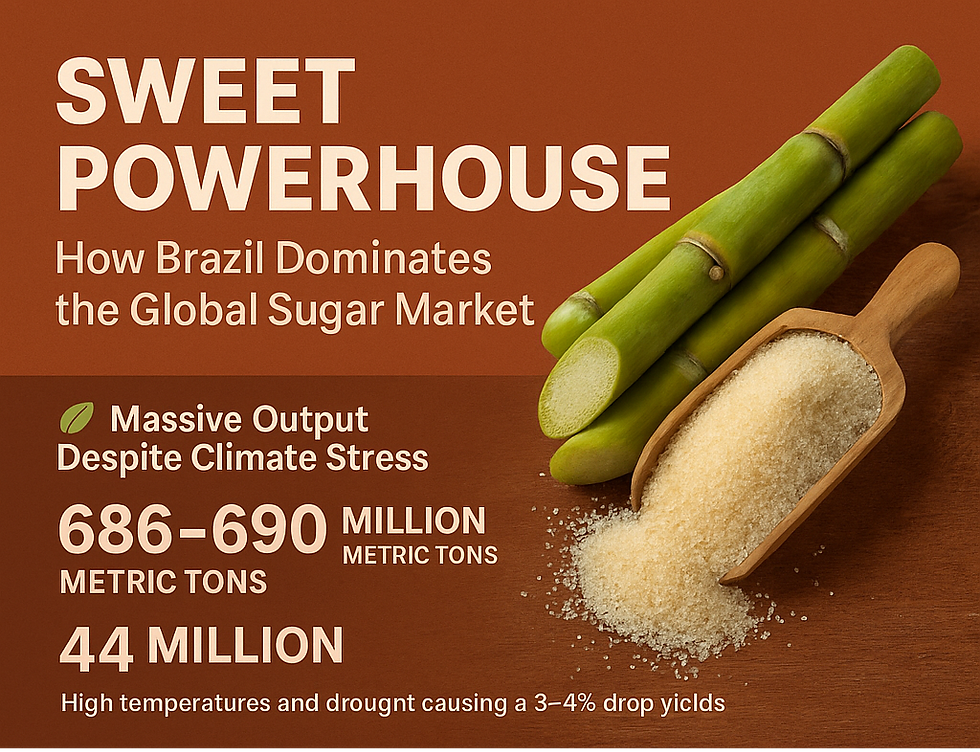
🌱 Massive Output Despite Climate Stress
Brazil's 2024/25 sugarcane harvest is projected to reach a staggering 686–690 million metric tons, maintaining its title as the world’s largest producer. However, this success comes with caveats. Unusually high temperatures and a prolonged drought—especially in the crucial Center-South region—have trimmed yields by about 3–4% from the previous year’s record highs.
“Up to 180 days without rainfall in key growing areas has impacted productivity, with yields dropping from 88.2 to 81.7 tons per hectare.”
Even so, Brazil is expected to churn out around 44 million metric tons of sugar, only slightly below last year’s historic peak. How? A combination of advanced crop management, increased planting areas, and the resilience of Brazil’s agro-industrial giants.
🏭 From Cane to Crystal: The Refinement Process
Brazil's sugar doesn’t stop at raw cane. The transformation into refined, high-quality products involves a complex and precise process:
Juice Extraction & Clarification
Evaporation into Syrup
Crystallization and Centrifugation
Final Refining (ICUMSA 45 for premium export)
These steps ensure Brazil’s refined sugar meets stringent global standards—especially ICUMSA 45, the gold standard in purity, used in everything from soft drinks to pharmaceuticals.
🌍 Export Giants and Global Markets
In 2024, Brazil exported a record 38.23 million tons of sugar, raking in $18.6 billion. Key buyers include:
Indonesia (3.46 million tons)
India
China
UAE
African nations like Algeria, Morocco, and Nigeria
Interestingly, China, once a top importer, tightened its import policies, enforcing tariff quotas and closing regulatory loopholes, limiting how much Brazilian sugar it can bring in.
Despite that, companies like Copersucar, Raízen, and São Martinho have flourished, with Copersucar alone exporting over 12 million tons.
📜 Regulation, Trade, and Strategy
Brazil maintains a relatively free-market approach to sugar exports. While there are no domestic quotas, some destination countries—especially China—impose strict limits and high tariffs on imports beyond certain volumes.
China allows 1.95 million tons at a 15% tariff; anything beyond that is taxed at 50%
The average buyer secures contracts 20–30 days in advance via letters of credit
Private contracts can span up to 5 years, although quota access is reviewed annually
🔍 The Road Ahead: Opportunities & Uncertainties
Brazil’s sugar dominance is impressive, but it's not invulnerable. Climatic volatility, evolving trade regulations, and shifting global demand could reshape the landscape. Still, with its robust infrastructure, diverse export base, and consistent investment in agricultural innovation, Brazil is well-positioned to stay at the top of the sugar game.
In essence, Brazil’s sugar sector is more than just agriculture—it's a strategic, export-driven machine that feeds the world while adapting to every twist and turn the global economy throws its way.


留言